
For Author
Vol. 5 No. 2 (2025): JURNAL KAJIAN KONSTITUSI
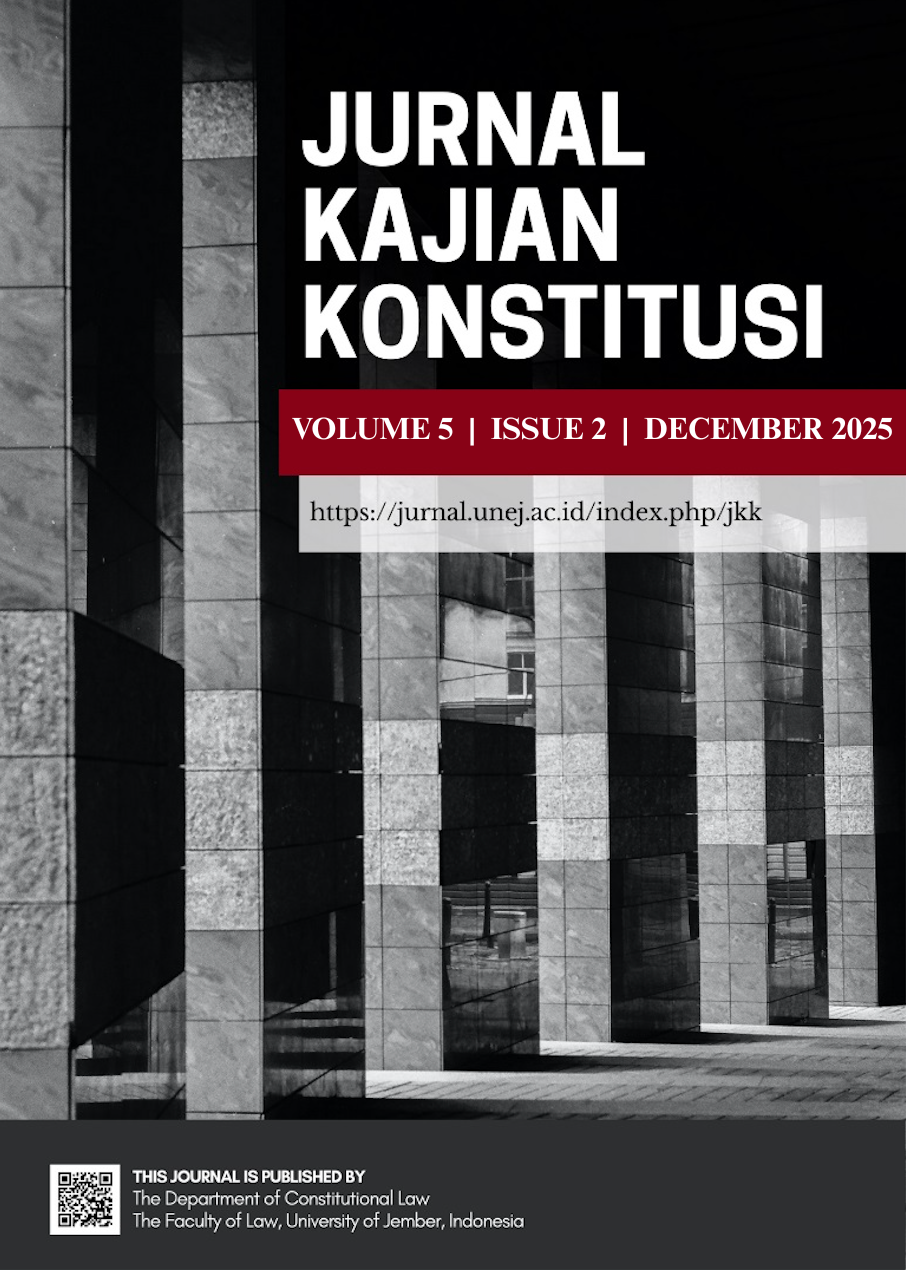
ISSN : 2962 - 3707 | Indexing: SINTA 4 | DOI : 10.19184/j.kk by 
The five articles in this edition offer diverse policy analyses through the lens of constitutionalism. Maharini et al. examine the issue of pre-legislative oversight by the judiciary—specifically, the Constitutional Court. Drawing on a comparative study of the “ex ante” review system in France, they explore uncharted territory for the Indonesian Constitutional Court, including the potential use of advisory opinions.
The dynamics of checks and balances and the separation of powers in policy formulation are also central to the work of Rayhan et al. They address the limitations that the Constitutional Court when adjudicating cases with the nature of "open legal policy." This highlights a complex relationship between political representation in parliament and the judicial authority of the Constitutional Court.
Amid growing awareness regarding the right to a healthy environment, Ananda et al. explore the concept of a "Green Constitution." They trace the normative foundations within the Indonesian legal system that are, to a certain extent, both relevant and crucial espescially with the current haze issue that we are facing. Furthermore, policies within a democratic setting presuppose an open space for civil society. In this context, Muhaimin et al analyze the exercise of the freedom of assembly in the context of civil society organizations (CSOs). They unpack the interplay between legal certainty, freedom of assembly, and public interest—as they relate to CSOs and civic participation—which both shape and are shaped by the policy-making process. Also, there can be no policy without a careful planning mechanism. Hasan et al. revisit the "Garis-Garis Besar Haluan Negara" (GBHN) and the possibility of its application within the contemporary legal system. They argue that the GBHN model remains relevant for strengthening long-term planning in policy formulation.
At last, we from the editorial team believed that all of the presented articles in this edition reflecting an effort to understanding and avoidung grammatical error within the “constitutional grammar”.
Published:
2025-12-30

