
For Author
Archives
-
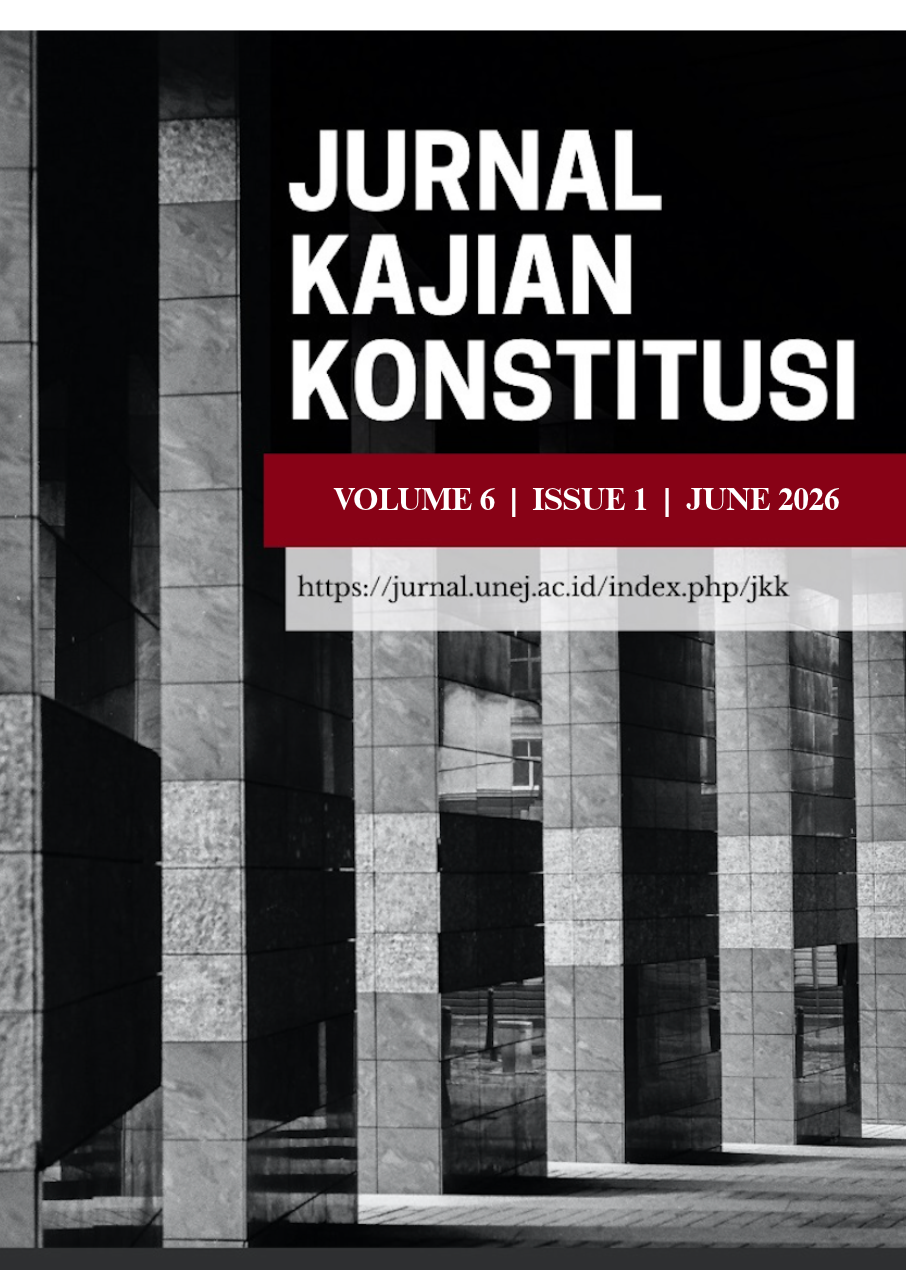
JURNAL KAJIAN KONSTITUSI
Vol. 6 No. 1 (2026)ISSN : 2962 - 3707 | Indexing: SINTA 4 | DOI : 10.19184/j.kk by

This edition features five articles examining issues in the scope of constitutional studies.
Ragsanjani et al. examine the constitutional tensions within the criminal justice system following a Constitutional Court ruling that implicitly legitimizes the fragmentation of investigative authority between the Financial Services Authority (OJK) and the Indonesian National Police (POLRI)—a situation currently lacking an adequate coordination mechanism to ensure the integrity of the criminal justice system and institutional accountability. A similar critical stance is also offered by Eraffif et al., who argue that the Constitutional Court’s ruling regarding anti-SLAPP clauses tends to be overly formalistic and procedural, whereas an environmental perspective demands a more substantive approach. A third article, by Setiawan, revisits and questions the Constitutional Court’s authority in disputes concerning regional head elections—a significant study for analyzing the aspects of legal certainty within the context of the dynamics of constitutional interpretation in Indonesia.
We have two more articles to explore. Manalu and Sihombing offer a critique of the Supreme Court's authority to conduct formal reviews of sub-statutory regulations, comparing this to the judicial review power held by the Constitutional Court. Meanwhile, Berutu and Nasution highlight the absence of legal remedies for the disqualification mechanism that caused by the violations of election law with the elements of structured, systematic, and massive.
We hope this edition will enrich scholarly discourse and provide valuable perspectives for academics, practitioners, and policymakers alike. -
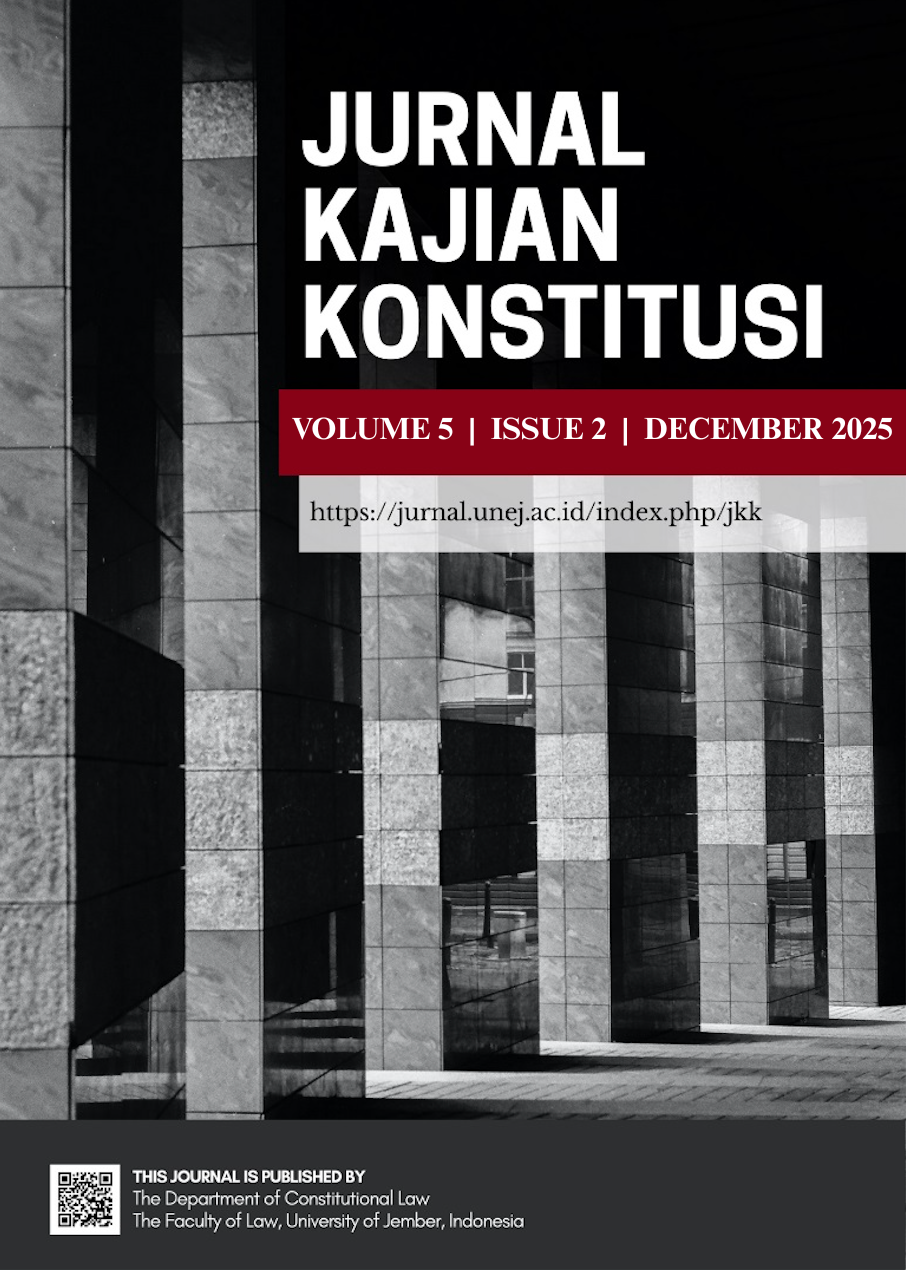
JURNAL KAJIAN KONSTITUSI
Vol. 5 No. 2 (2025)ISSN : 2962 - 3707 | Indexing: SINTA 4 | DOI : 10.19184/j.kk by
The five articles in this edition offer diverse policy analyses through the lens of constitutionalism. Maharini et al. examine the issue of pre-legislative oversight by the judiciary—specifically, the Constitutional Court. Drawing on a comparative study of the “ex ante” review system in France, they explore uncharted territory for the Indonesian Constitutional Court, including the potential use of advisory opinions.
The dynamics of checks and balances and the separation of powers in policy formulation are also central to the work of Rayhan et al. They address the limitations that the Constitutional Court when adjudicating cases with the nature of "open legal policy." This highlights a complex relationship between political representation in parliament and the judicial authority of the Constitutional Court.
Amid growing awareness regarding the right to a healthy environment, Ananda et al. explore the concept of a "Green Constitution." They trace the normative foundations within the Indonesian legal system that are, to a certain extent, both relevant and crucial espescially with the current haze issue that we are facing. Furthermore, policies within a democratic setting presuppose an open space for civil society. In this context, Muhaimin et al analyze the exercise of the freedom of assembly in the context of civil society organizations (CSOs). They unpack the interplay between legal certainty, freedom of assembly, and public interest—as they relate to CSOs and civic participation—which both shape and are shaped by the policy-making process. Also, there can be no policy without a careful planning mechanism. Hasan et al. revisit the "Garis-Garis Besar Haluan Negara" (GBHN) and the possibility of its application within the contemporary legal system. They argue that the GBHN model remains relevant for strengthening long-term planning in policy formulation.
At last, we from the editorial team believed that all of the presented articles in this edition reflecting an effort to understanding and avoidung grammatical error within the “constitutional grammar”. -
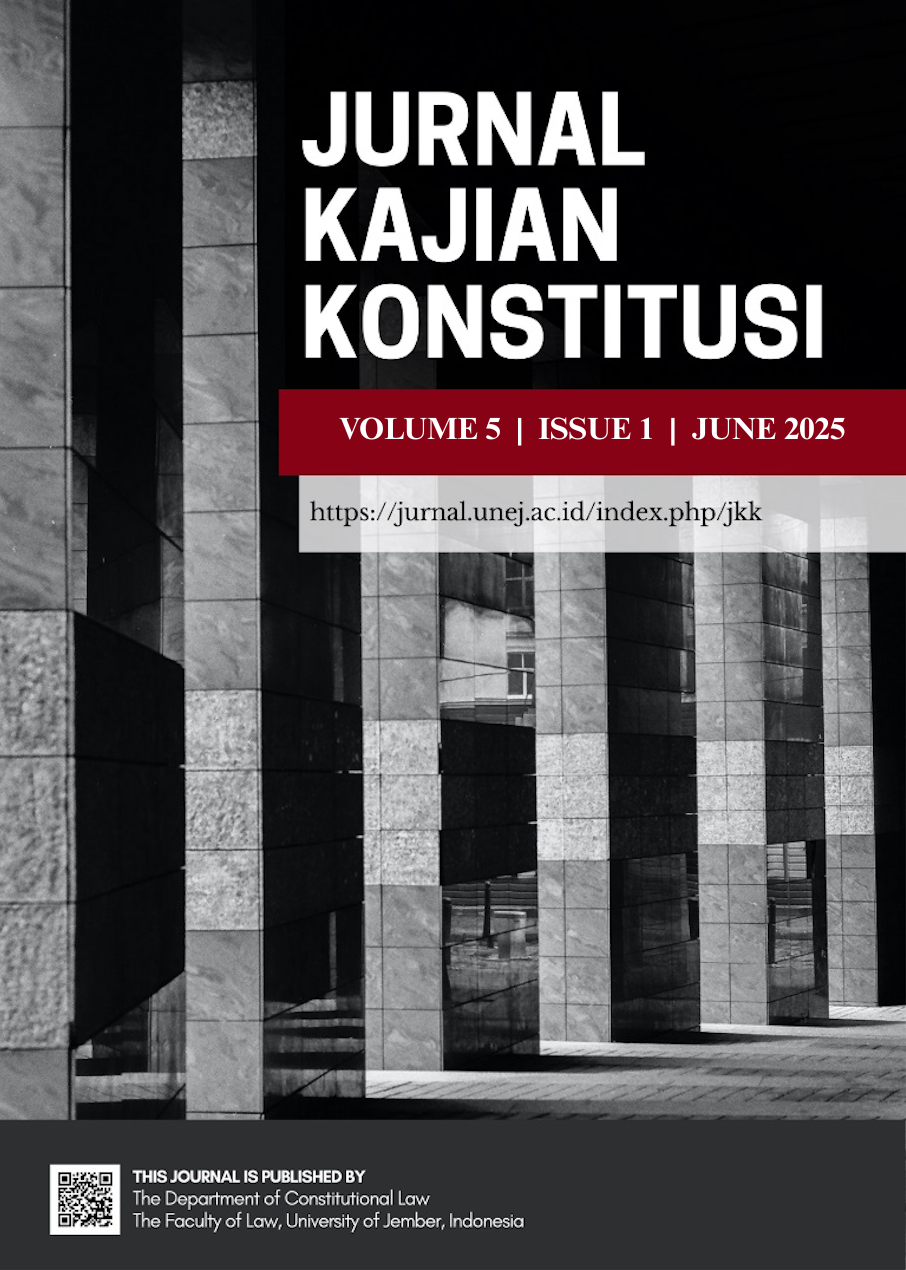
JURNAL KAJIAN KONSTITUSI
Vol. 5 No. 1 (2025)ISSN : 2962 - 3707 | Indexing: SINTA 4 | DOI : 10.19184/j.kk by
This edition features eight articles examining issues within constitutional studies. A common thread runs through them: constitutional norms are already in place, yet their implementation in judicial decisions, derivative regulations, and institutional practice remains inconsistent.
Puteri examines the extent to which the Constitution and the Constitutional Court interpret the principle of sustainability within the framework of a green constitution. The study finds that the principle is reflected in Articles 28H(1), 33(3), and 33(4) of the 1945 Constitution, as well as in several Constitutional Court rulings, yet it is not fully aligned with implementing regulations such as the Job Creation Law. Purba et al. offer a similar critical stance, highlighting lawmakers' failure to follow up on non-self-implementing Constitutional Court rulings as ordered, and even interpreting them differently. Drawing on comparisons with Germany and South Korea, they argue that lawmakers should comply with the legal considerations and operative parts of the rulings, and that the Court should explicitly set time limits or delayed enforcement dates.
A third article, by Dairani and Fadlail, revisits the discourse on amending the 1945 Constitution. They argue that presidential term limits are the primary mechanism for safeguarding democracy, while the presidential system must be strengthened through institutional reform that guarantees the separation of powers and effective checks and balances. From a theoretical perspective, Rahman and Amir trace the thought of contemporary Islamic scholars, including Rachid Ghannouchi, Ahmad Raysuni, and Nurcholish Madjid, concluding that democracy can be compatible with the principles of shura and siyasah shar'iyyah in building a just and balanced nation-state.
We have four more articles to explore. Annafi et al. analyze the implications of the change in status of state universities to legal-entity state universities (PTN-BH) for regional taxation, finding that PTN-BH may become taxpayers for certain types of taxes, which necessitates coordination among relevant agencies. Rifan et al. turn to decentralization in Aceh, showing that Aceh Qanun Number 9 of 2012 is "disconnected" from the national development planning system and therefore requires re-harmonization through the 2025-2045 Aceh Long-Term Development Plan.
Meanwhile, Baso et al. question the absence of passing off regulation in Indonesian trademark law, which protects only registered marks, and conclude that passing off is not appropriate for adoption due to differences between legal systems. Finally, Emha et al. highlight the legal gap in providing houses of worship in residential housing, which under Law Number 1 of 2011, as amended by Law Number 6 of 2023, constitutes part of housing facilities; criminal sanctions are to be treated as ultimum remedium, with disputes first resolved through deliberation.
We hope this edition will enrich scholarly discourse and provide valuable perspectives for academics, practitioners, and policymakers alike. -
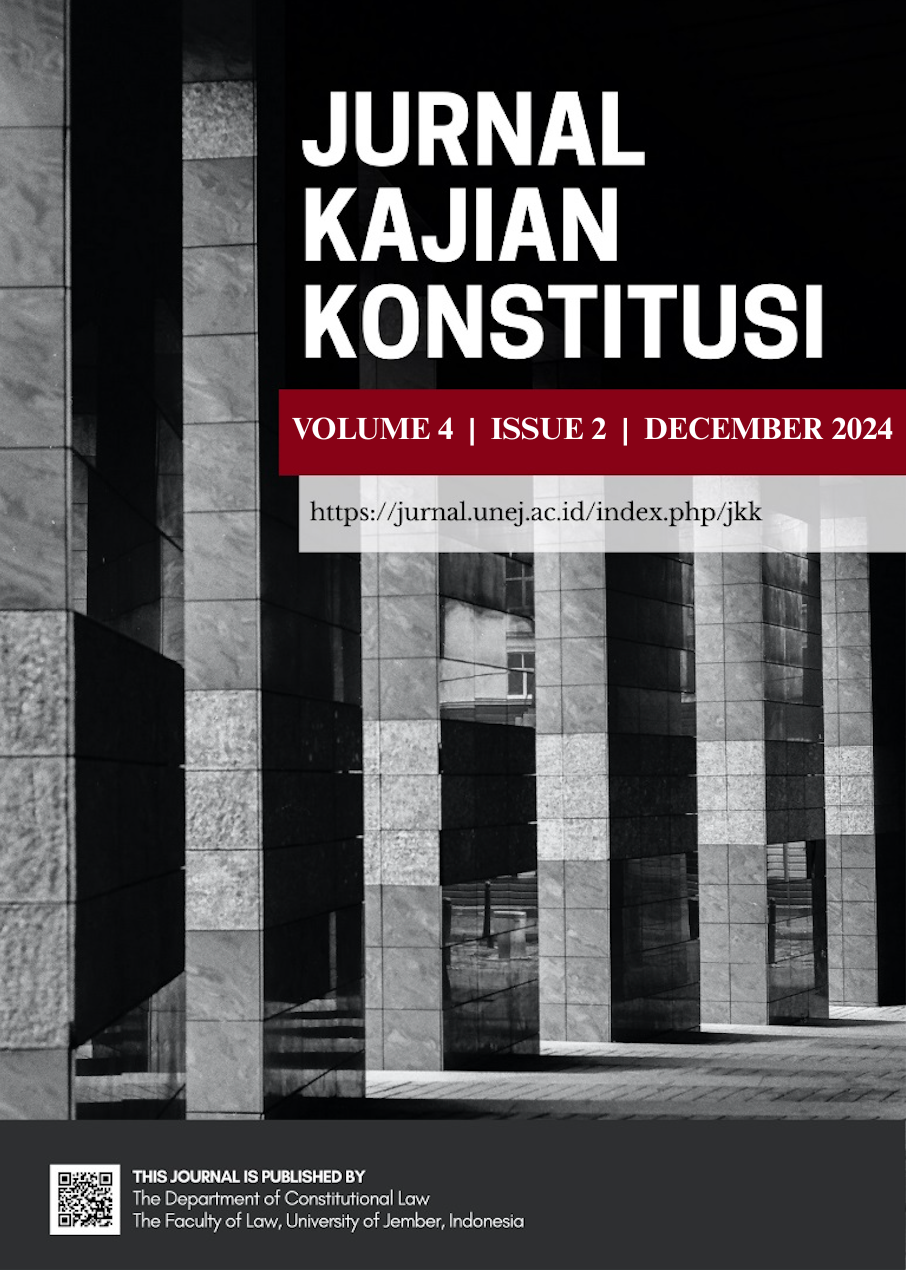
JURNAL KAJIAN KONSTITUSI
Vol. 4 No. 2 (2024)ISSN : 2962 - 3707
First Publication : 2021
Language : Indonesian and English
Publisher : University of Jember, Indonesia
Indexing: SINTA 4
Frequency : 2 issues per year
DOI : 10.19184/j.kk by
Audience : Legal scholars and Legal Practitioners -

JURNAL KAJIAN KONSTITUSI
Vol. 4 No. 1 (2024)ISSN : 2962 - 3707
First Publication : 2021
Language : Indonesian
Publisher : University of Jember, Indonesia
Duration : Approx 15 days of submission to decision
Frequency : 2 issues per year
DOI : 10.19184/j.kk by
Audience : Scholars and practitioners interested to study legal and constitutional studies -
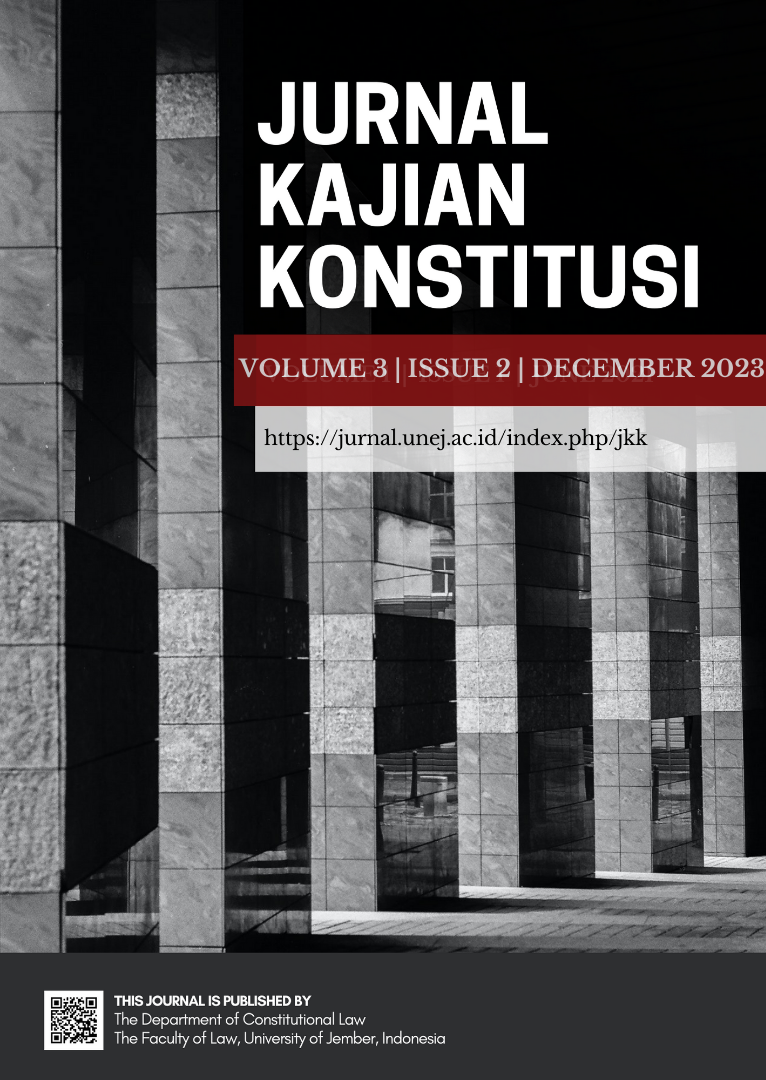
JURNAL KAJIAN KONSTITUSI
Vol. 3 No. 2 (2023)ISSN : 2962 - 3707 (Online)
First Publication : 2021
Language : Indonesian
Publisher : University of Jember, Indonesia
Duration : Approx 15 days of submission to decision
Frequency : 2 issues per year
DOI : 10.19184/j.kk by
Audience : Scholars and practitioners interested to study legal and constitutional studies -
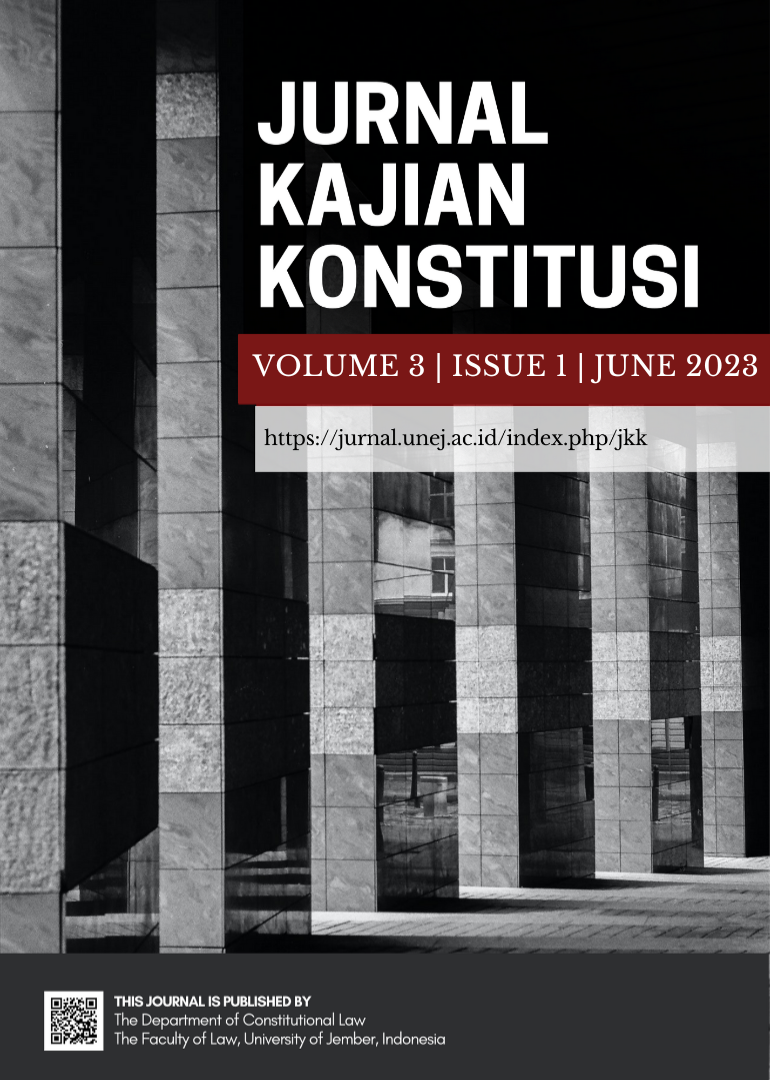
JURNAL KAJIAN KONSTITUSI
Vol. 3 No. 1 (2023)ISSN : 2962 - 3707 (Online)
First Publication : 2021
Language : Indonesian
Publisher : University of Jember, Indonesia
Duration : Approx 15 days of submission to decision
Frequency : 2 issues per year
DOI : 10.19184/j.kk by
Audience : Scholars and practitioners interested to study legal and constitutional studies -
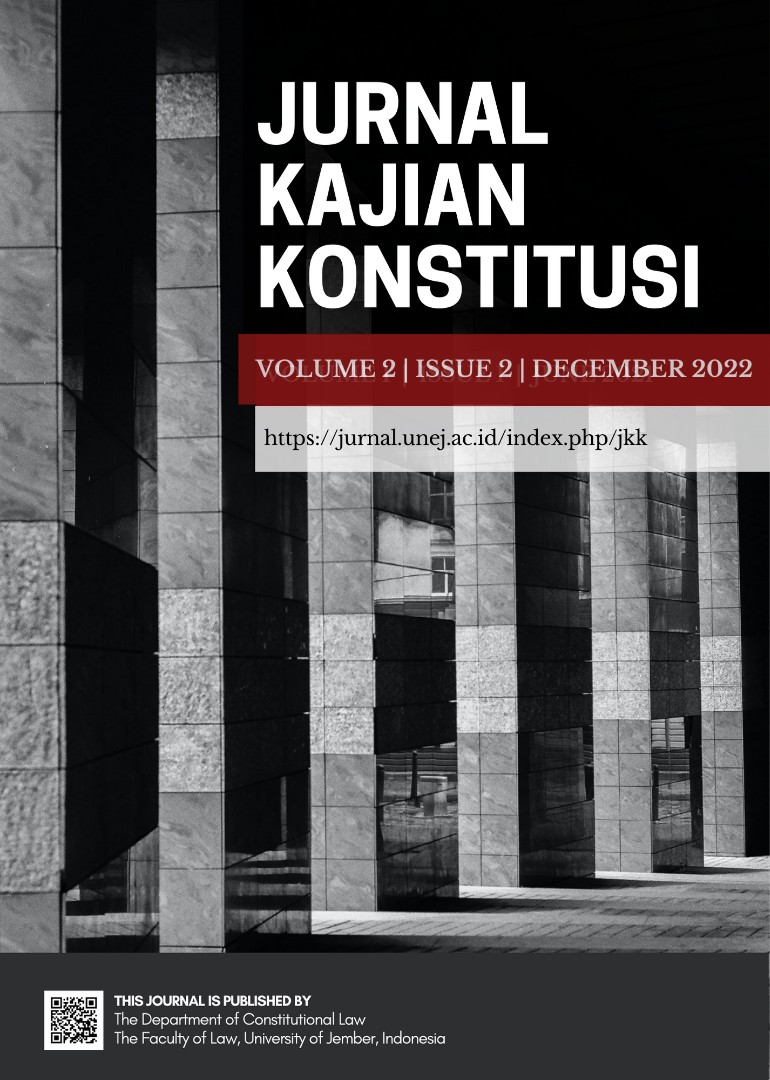
JURNAL KAJIAN KONSTITUSI
Vol. 2 No. 2 (2022)ISSN : 2962 - 3707 (Online)
First Publication : 2021
Language : Indonesian
Publisher : University of Jember, Indonesia
Duration : Approx 15 days of submission to decision
Frequency : 2 issues per year
DOI : 10.19184/j.kk by
Audience : Scholars and practitioners interested to study legal and constitutional studies -
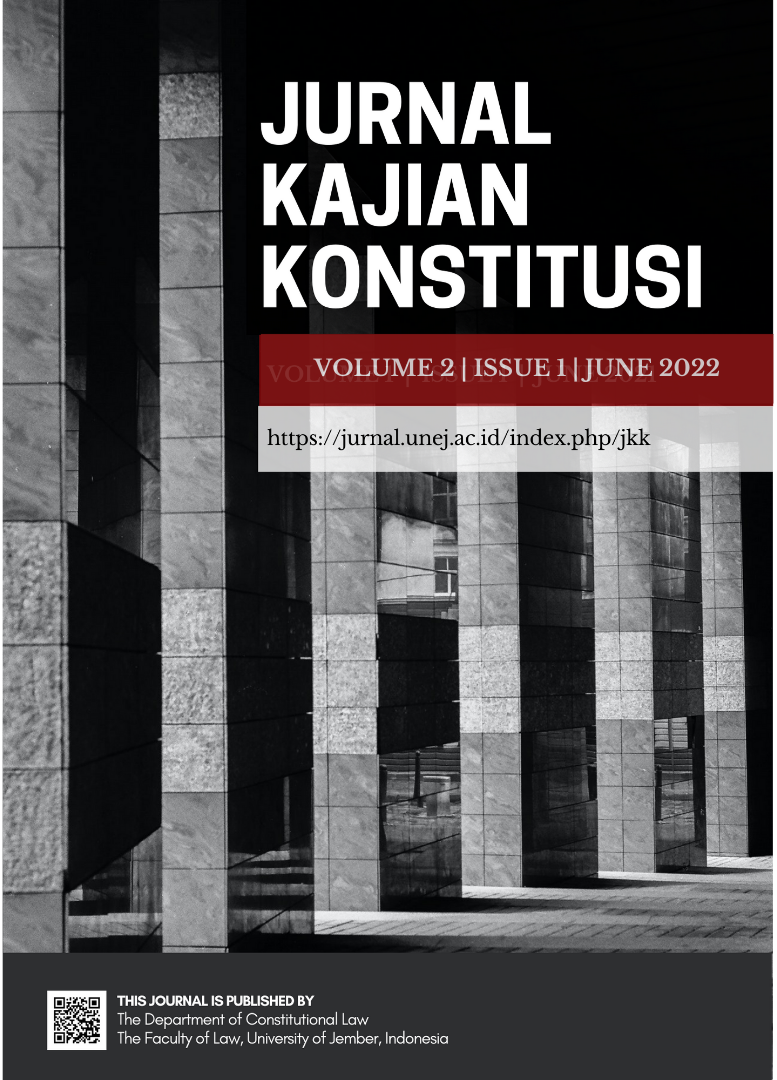
JURNAL KAJIAN KONSTITUSI
Vol. 2 No. 1 (2022)ISSN : 2962 - 3707 (Online)
First Publication : 2021
Language : Indonesian
Publisher : University of Jember, Indonesia
Duration : Approx 15 days of submission to decision
Frequency : 2 issues per year
DOI : 10.19184/j.kk by
Audience : Scholars and practitioners interested to study legal and constitutional studies -
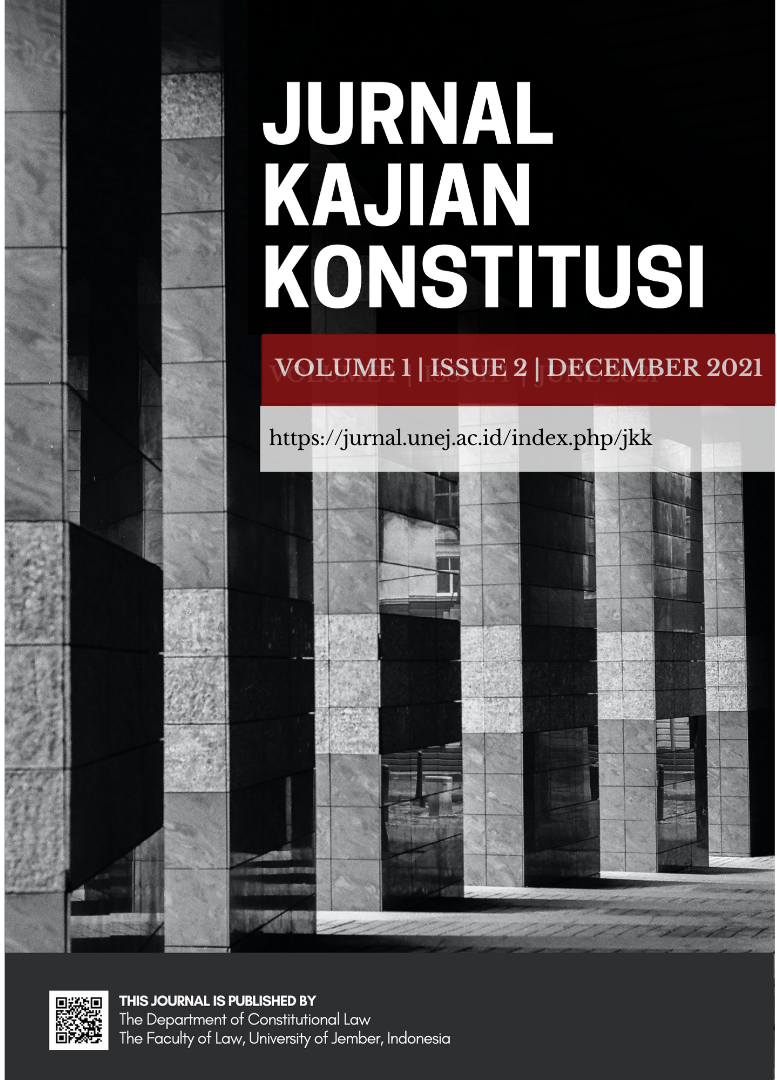
JURNAL KAJIAN KONSTITUSI
Vol. 1 No. 2 (2021)First Publication : 2021
Language : Indonesian
Publisher : University of Jember, Indonesia
Duration : Approx 15 days of submission to decision
Frequency : 2 issues per year
DOI : 10.19184/j.kk by
Audience : Scholars and practitioners interested to study legal and constitutional studies -
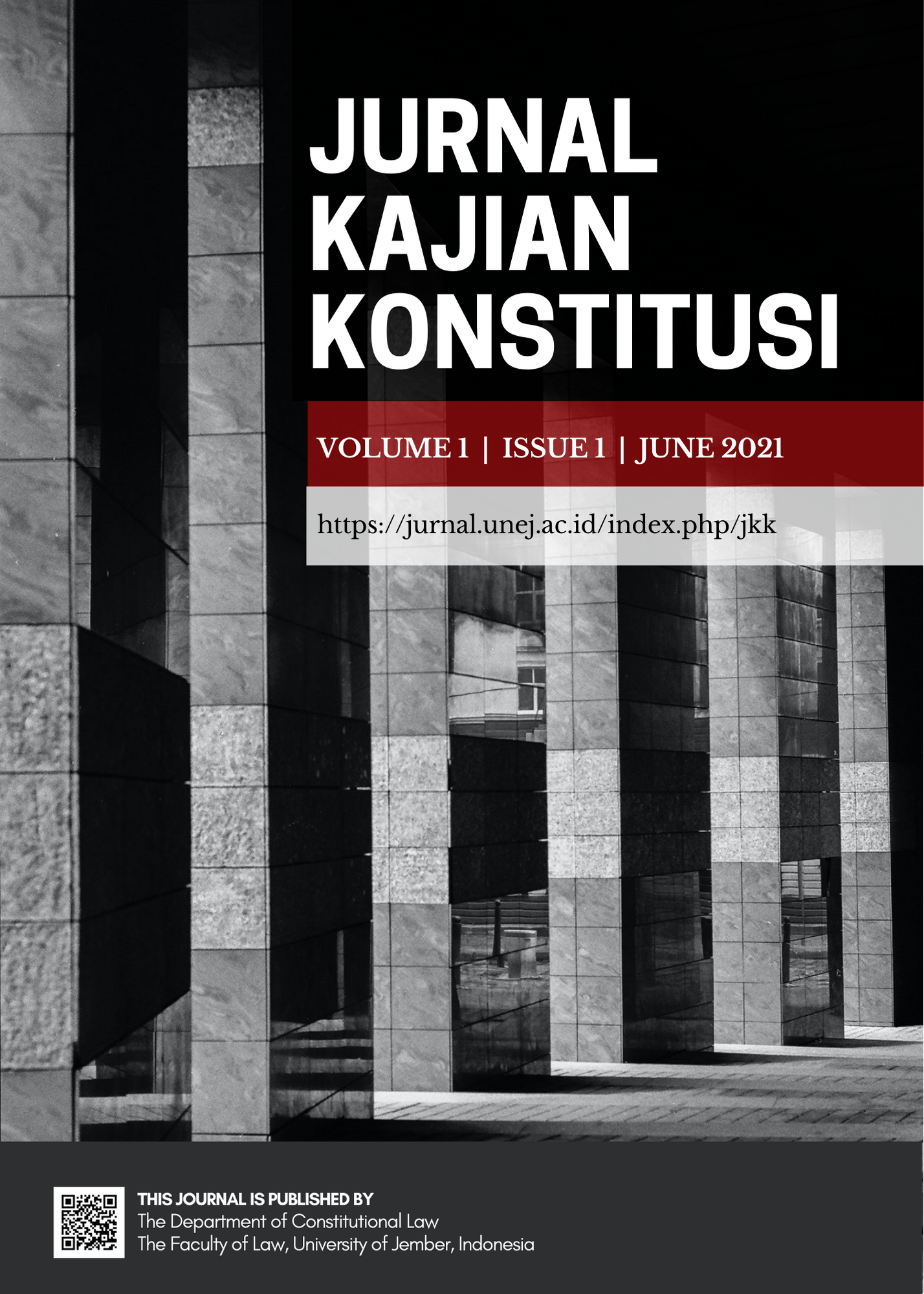
JURNAL KAJIAN KONSTITUSI
Vol. 1 No. 1 (2021)First Publication : 2021
Language : Indonesian
Publisher : University of Jember, Indonesia
Duration : Approx 15 days of submission to decision
Frequency : 2 issues per year
DOI : 10.19184/j.kk by
Audience : Scholars and practitioners interested to study legal and constitutional studies

